
www.indo-industry.com
19
'26
Written on Modified on
Low-Voltage Metro Electrification for Urban Rail Infrastructure
ABB supplies low-voltage power distribution switchgear and energy management architectures to secure continuous station auxiliary power across MRT Jakarta Phase 2.
global.abb
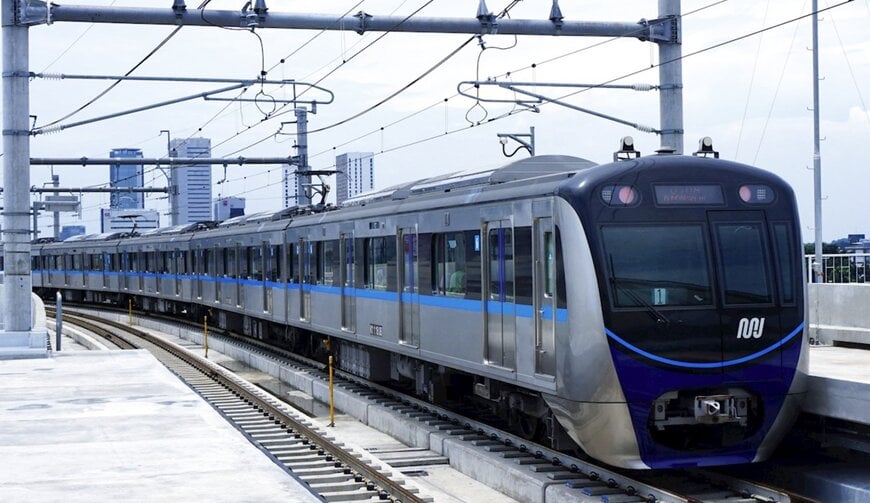
High-capacity underground urban transit networks require resilient auxiliary power distribution to safeguard continuous operations across critical sub-systems, including tunnel ventilation, emergency lighting, traction substations, platform screen doors, and signaling rooms. In dense metropolitan regions, electrical infrastructure must combine high short-circuit withstand capabilities, modular arc-fault protection, and continuous digital energy monitoring within space-constrained subterranean footprints. To support the northern expansion of Jakarta’s mass transit corridor, ABB was selected to provide low-voltage electrification systems for Mass Rapid Transit (MRT) Jakarta Phase 2 under Indonesia’s National Strategic Program.
Low-Voltage Switchgear and Substation Architecture
For the Phase 2 expansion, ABB deploys low-voltage energy distribution hardware centered on its System Pro E Power switchgear platform and System Pro M compact modular DIN-rail distribution devices. To support domestic industrial capacity, a portion of the System Pro E Power switchgear production is executed locally within Indonesia.
The switchgear assemblies and modular circuit protection components are progressively installed inside dedicated underground electrical panel rooms to establish isolated, fault-tolerant power pathways. By segmenting auxiliary circuits, the architecture mitigates arc flash risks, improves maintenance safety for facility technicians, and protects vital station loads against power continuity disruptions. Commissioning of the electrical distribution systems is scheduled for completion in 2027 to coincide with the planned operational opening of the initial Bundaran HI–Monas station segment.
Phased Underground Corridor Expansion
The electrification package supports the multi-stage northern extension of the operational North–South Line, expanding outward from the Phase 1 terminus at Bundaran HI:
Phase 2A covers 5.8 kilometers of subterranean infrastructure connecting seven underground stations between Bundaran HI and Kota. Initial commercial operations for the Bundaran HI–Harmoni segment are targeted for 2027, with the remaining section extending to Kota scheduled for completion in 2029.
Phase 2B extends the alignment by approximately 6 kilometers through two additional underground stations at Mangga Dua and Ancol, with full infrastructure delivery targeted for 2032.
Integrating digital energy management systems across these subterranean passenger hubs provides centralized visibility into load profiles and equipment diagnostics. This real-time oversight supports peak-load balancing, prevents localized circuit overloading, and establishes an energy-efficient foundation for a metropolitan area serving over 42 million residents.
Additional Context
This section details technical specifications and competitive benchmarking not included in the original product announcement.
In subterranean metro rail electrification, low-voltage power distribution systems are governed by the IEC 61439-1 and IEC 61439-2 standards for low-voltage switchgear and controlgear assemblies. To guarantee personal safety and equipment survival in confined underground vaults, switchgear designs must satisfy Internal Arc Classification criteria under IEC TR 61641, providing arc-containment ratings up to 65 kA or 100 kA for 0.3 seconds. Standard transit specifications require Form 4b internal physical separation, completely segregating busbars, functional switching units, and external cable termination lugs to allow technicians to service individual outgoing feeder buckets without de-energizing adjacent operational circuits.
Within the regional railway electrification market, ABB's System Pro E Power competes directly with low-voltage switchgear platforms such as Schneider Electric's Okken and Blokset ranges, and Siemens' SIVACON S8. While baseline medium-to-low voltage step-down transformers handle auxiliary conversion from 20 kV distribution rings, competitive benchmarks focus on nominal busbar current carrying capacity (up to 6,300 A), thermal dissipation efficiency in unventilated underground rooms, and native integration with intelligent electronic devices via open protocols such as IEC 61850 and Modbus TCP. Deploying modular switchgear with local manufacturing participation aligns with strict Indonesian Domestic Component Level (TKDN) regulatory requirements while delivering seismic withstand compliance required for underground transit corridors along active tectonic fault zones.
Edited by Romila DSilva, Induportals Editor, with AI assistance.
www.abb.com
