
www.indo-industry.com
14
'26
Written on Modified on
Acwa signs joint development agreement with PT GARAM
Approximately USD 400 million project designed to produce around 62,500 cubic meters of desalinated water per day and 500,000 tons of high-purity industrial salt a year.
www.acwapower.com
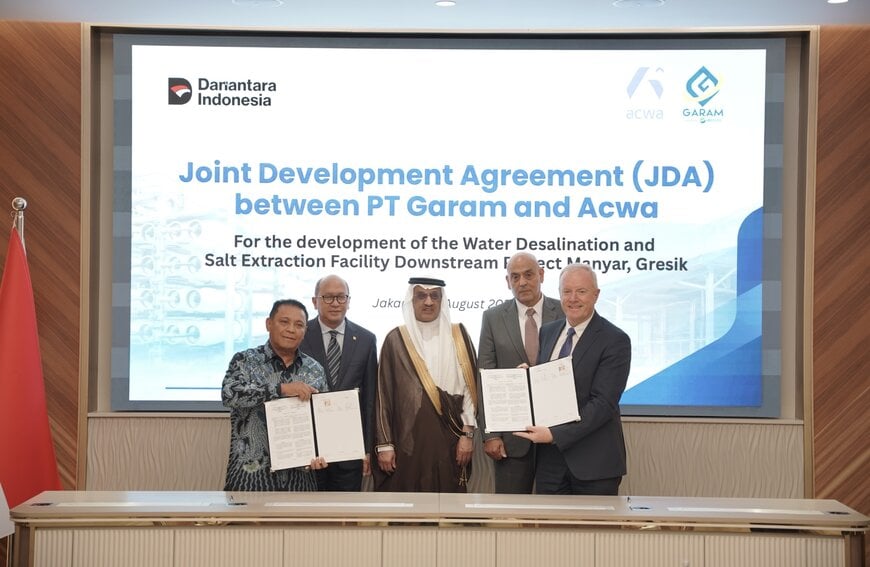
Acwa has signed a Joint Development Agreement with Indonesian state-owned salt enterprise PT GARAM to build an integrated seawater reverse-osmosis desalination and industrial salt production facility in East Java, Indonesia.
The project will be located in Manyar, Gresik, and operates under a Build-Own-Operate framework structured with limited or non-recourse project financing. The facility is designed to yield approximately 62,500 cubic meters of desalinated water daily alongside 500,000 tons of high-purity industrial salt annually.
Process Design and Mineral Recovery
The plant utilizes a seawater reverse-osmosis (SWRO) process that integrates salt extraction into its brine-management stream. By harvesting high-purity industrial salt from concentrated brine, the project provides water for industrial consumption while supplying domestic salt to offset national import requirements. The operational layout also accommodates potential future recovery of secondary marine minerals from the brine stream.
Scope of Operations and Development Roles
Acwa will oversee technology selection, engineering, procurement, construction (EPC), technical design, and long-term operations and maintenance (O&M). The company is also responsible for the project's financial structuring and implementing technology transfer and workforce training protocols for local personnel.
PT GARAM is managing site preparation, land access, regulatory permitting, and local stakeholder coordination. Additionally, PT GARAM will handle commercial distribution and off-take channels for the facility's water and salt output across Indonesian markets.
Additional Context
This section details technical specifications not included in the original news release.
Seawater Reverse Osmosis (SWRO) relies on high-pressure semi-permeable membranes (typically polyamide thin-film composites) to overcome natural osmotic pressure—operating at pressures between 55 bar and 80 bar—to separate fresh water from saline feed streams. Standard SWRO operations convert approximately 40% to 45% of incoming seawater into potable or industrial-grade permeate, leaving behind a concentrated liquid byproduct known as reverse osmosis brine (brine concentration usually exceeds 60,000 to 70,000 mg/L of Total Dissolved Solids).
In traditional installations, this brine is discharged back into marine environments via multi-port diffusers. Integrated salt extraction utilizes Zero Liquid Discharge (ZLD) or Minimal Liquid Discharge (MLD) process topologies. The concentrated brine undergoes secondary concentration stages—such as electrodialysis, mechanical vapor recompression (MVR), or specialized nanofiltration—to isolate specific ionic species before entering crystallization units. This process yields industrial-grade sodium chloride with purities often exceeding 99.5%, while enabling the potential downstream extraction of valuable trace minerals, including magnesium, bromine, and lithium.
Edited by Romila DSilva, Induportals Editor, with AI assistance.
www.acwapower.com
